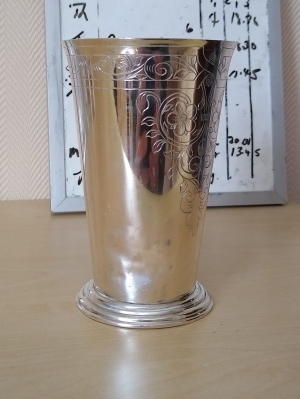
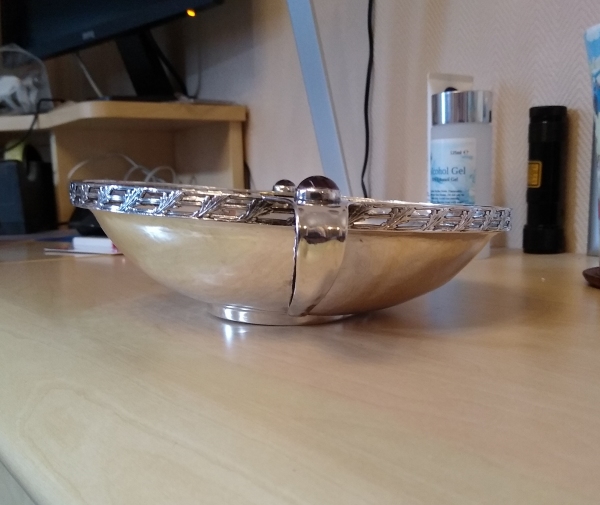
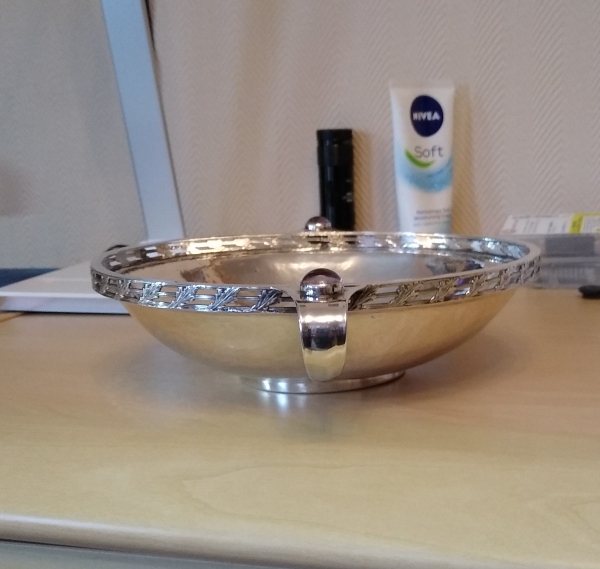
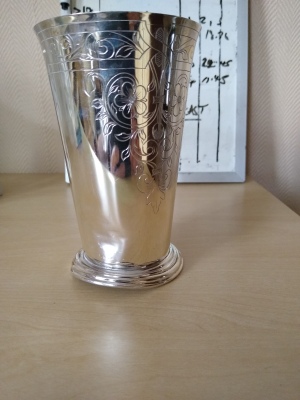
This is an example of a fit for purpose repair rather than a perfect restoration. The owner has happy to have a few dents as part of it’s character, but not to the extent of the base being uneven and so unstable that it couldn’t hold her drink safely.
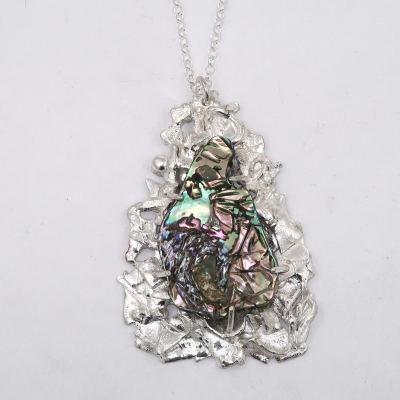
The varying colours of the shell combined with the random nature of the fused silver surround make for a striking, three dimensional pendant. This is about 8cm high and weighs over 35g. Each fused pendant starts with the stone and the surround is created to complement it.
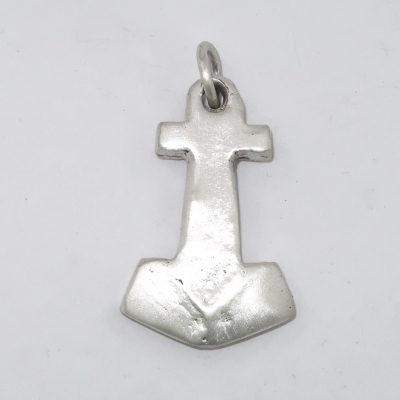
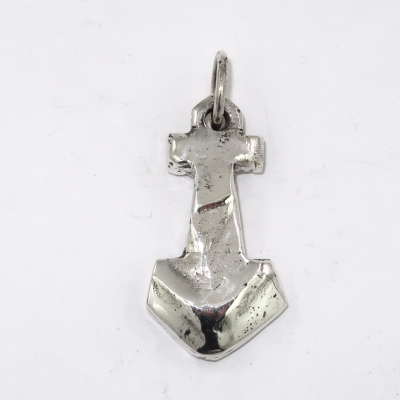
Two examples of representations of Thor’s hammer. They are both about 50mm high and solid sterling silver – they weigh about 50g each. The design was driven by the client who wanted an ‘authentic’ look rather than refined, so you can see defects from the casting. The brief was also this style and not the shaft and head style hammer. The left hand one has a satin finish, as the client requested, whereas the right hand is shiny. The shiny one is available from my shop. I could remove more of the casting defects and satinise that if required. UK hallmarks are on the rear. I made clay models as the patterns for the castings, so I could repeat the left hand one too. These are about the limit of my modelling skills.
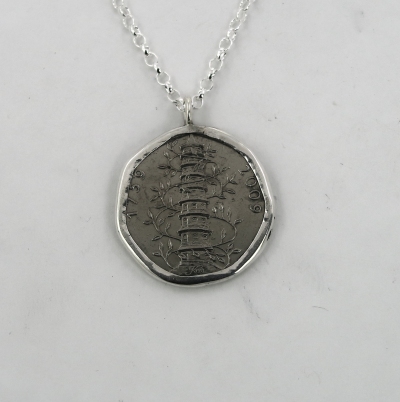
Suprisingly, this is probably one of the most expensive coins I have mounted. The original issue of the coin is very much a limited edition. Anyway, of the mount, the owner said
‘ Coin pendant received thank you . I am very pleased. It is more impressive than I expected . Your work is very much appreciated.’
The coin is held in a fine silver (99.9% pure) band that is burnished over the coin. Fine silver is so soft that the silver blends back into the bulk forming a tight, secure , but completely non-destructive support for the coin. Both sides are equally visible.
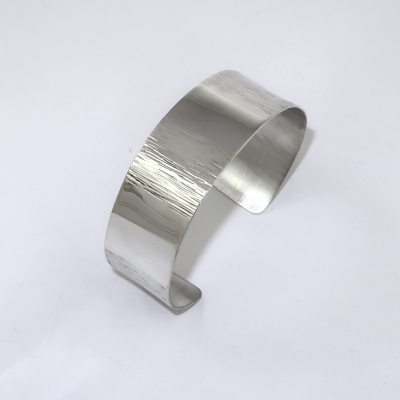
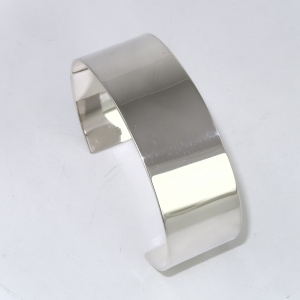
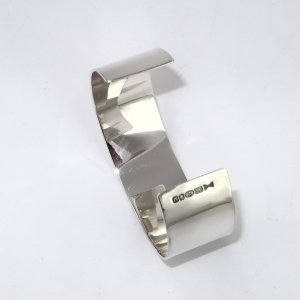
This bracelet has alternate bands of bright polished silver and a hammered pattern that looks vaguely like a bark effect.. It’s a design I’ve used before and can be seen on my shop bracelets page, though it is only made on request. My client saw that picture and said it was great, but could it be wider. The answer is ‘yes – of course. How wide would you like it?’
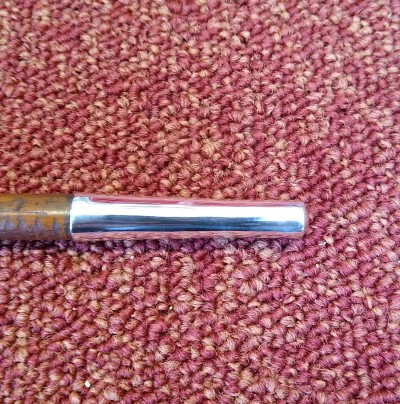
Another little challenge has been to produce a tapered tube. This is my replacement for the tip that had got lost from a swagger stick – a stick carried usually by military officers to denote authority.
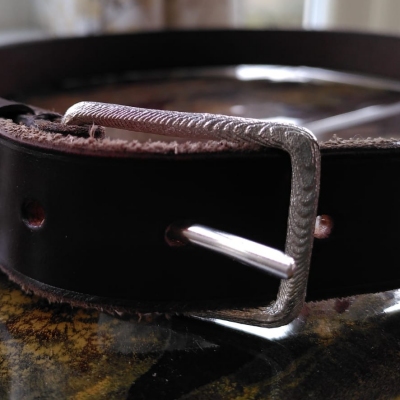
This silver belt buckle was cast in a cuttlefish bone. The rippled texture that you see is inherent in the bone itself and therefore unique. The texture is made prominent after the basic shape is formed in the bone, but before the metal is cast. The rectangle was cast in one piece and so required a large bone. Cuttlefish bone is a good insulant allowing the silver to stay molten long enough to penetrate the relative long narrow channels by gravity.
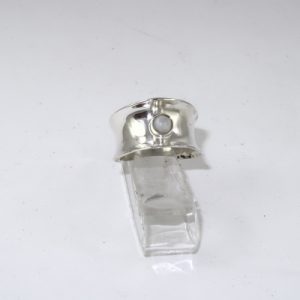
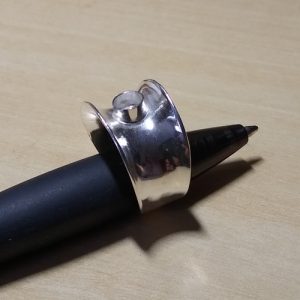
The pearl in this ring was found whilst sea foraging in Normandy many years ago. Although it is rough and irregular, it has sentimental value. My brief was that the ring would be worn daily and so needed to protect the pearl. I suggested an anticlastic ring, which appealed to the owner as she is a mathematician and instantly knew what I meant. (It has both convex and concave curves – most rings only have one or two convex curves.)
The left hand image shows the finished ring and the right hand image before lowering the collar and setting the pearl. The pearl is well protected from casual imapcts.
‘Just to let you know that I absolutely adore the ring you made. I wear it every single day, and my family was blown away by how beautiful it is, and ‘true’ to the type of pearl it is.’
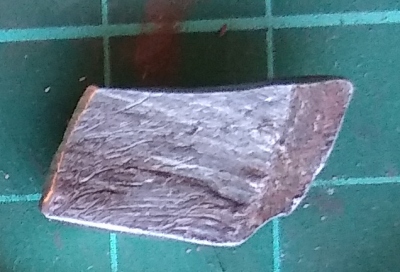
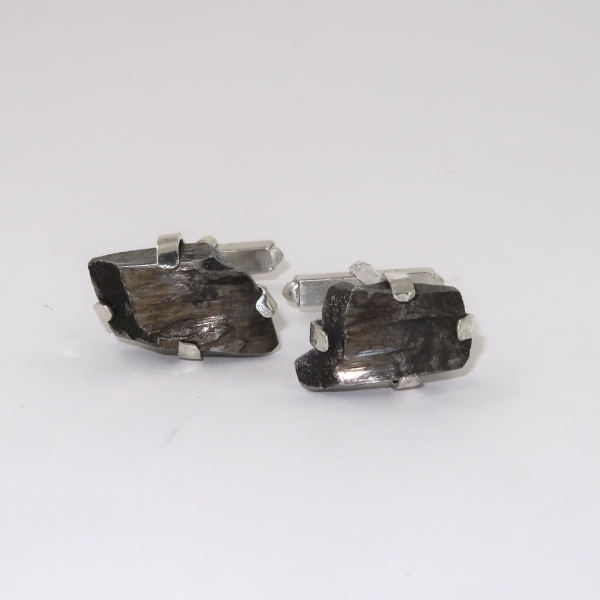
This is a piece of a bomb casing from a bomb dropped during the Vietnam war that was subsequently safely destroyed. Some edges were as sharp as a knife.
These are the cufflinks I made by cutting it in two and removing the sharp edges.
Minimalist to keep the weight down and focus on the content not the cufflink, yet safe and secure. Something to talk about at a dinner party?
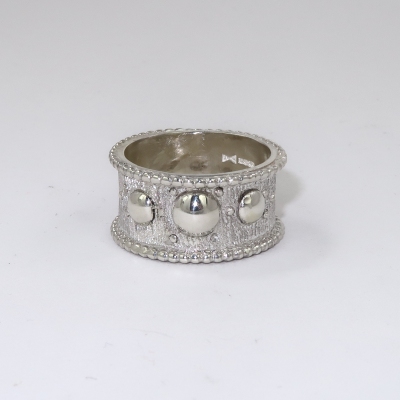
This ring was really just a test piece for a commission which mixed silver and gold. It enabled me to determine the sizes of the various elements and develop the manufacturing process. The real thing has garnets instead of the domes and all the beads and beading are gold. You can see it here.
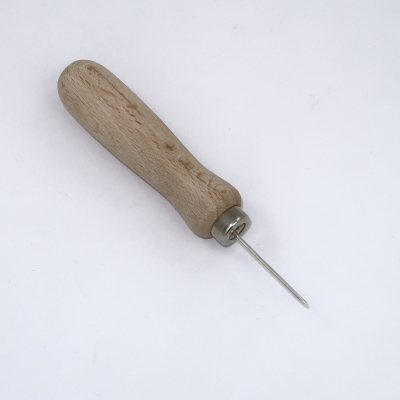
I’ve been asked twice in the last year to make a chalky paper tester. It’s a piece of fine silver wire that is rubbed on the perforation of a stamp and apparently indicates whether the paper is chalky or not. It must be something akin to silverpoint drawing. I decided to make one for my shop.
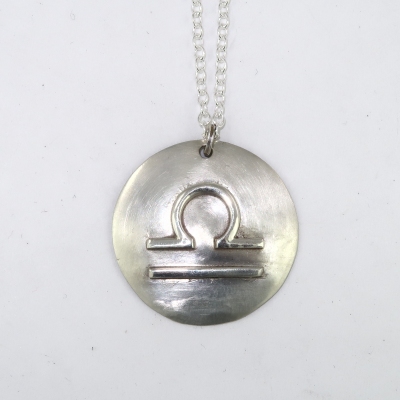
One form of the star sign for Libra. In this case , bright polished on a satinised and slightly domed background. This is about 2.5cm in diameter. All hand fabricated.
Some repairs I can do, some I can’t. Some bends, marks and dints, I can fix and some I can make look less obvious, but not a perfect restoration. This is an example of a bowl that I made much better, but not perfect.
BeforeAfter
I like to see at least pictures of the piece before I commit to doing anything and any repair I do is subject to my terms and conditions.
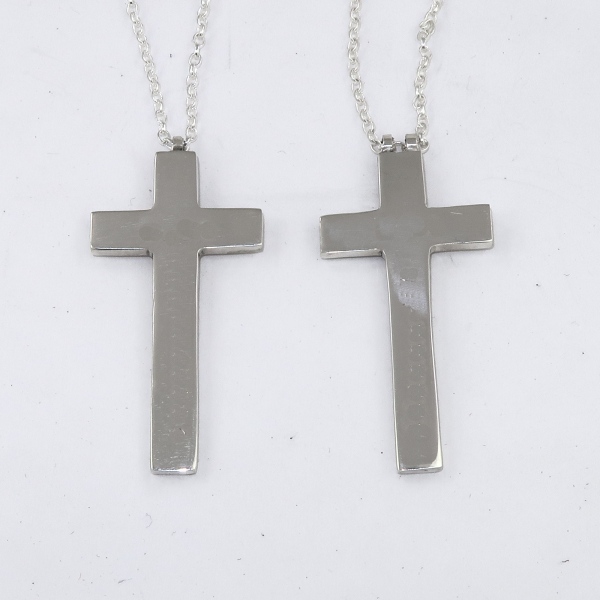
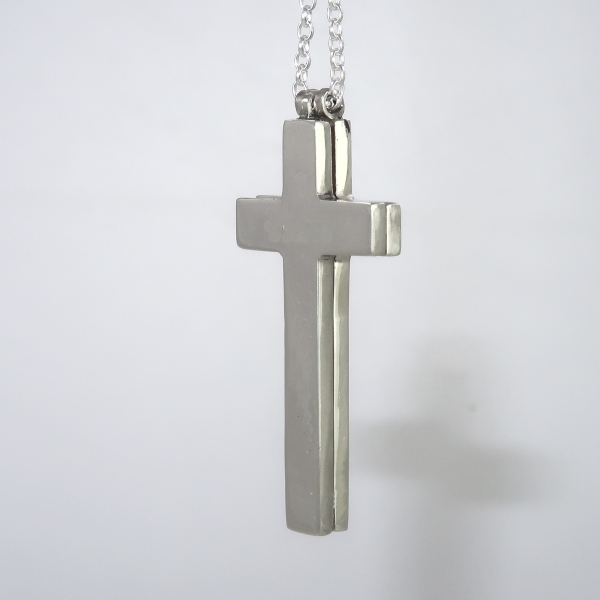
As a Christmas present, I was asked to make a pair of crosses for husband and wife each engraved with their names and date of their wedding. So far, so good.
The engraving has been photo erased
There was a further requirement that the two crosses could be worn together. This was achieved by having silightly different chain rings, both offset to the rear. Gravity then causes the two to hang together. Simple idea, but requiring more precision than normal for me!
The engravng has been photo erased
The crosses are both hallmarked on their rear face.
Since I was commissioned in 2009 to make 21 as prizes, I’ve made over 80 of my silver hazelnuts and sold 75 so far. They are incorporated into jewellery from cufflinks to key fobs, but most are pendants.
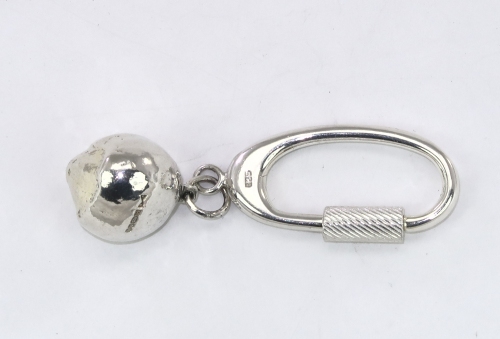
Silver hazelnut keyring
Of those 75, as far as I know
One went to France
One went to Germany
One went to Spain
Six are in Australia
Two went to Canada
One is in Japan
Three are in the USA
The remainder are in the UK – from the Shetland Islands south.
I like it when people tell me why they were bought. Often it is for or in memory of someone call ‘Hazel’, occasionally associations with Julian of Norwich or just personal memories.
The lastest crop of full hazelnuts will be ready during January 2021.
Please if you live outside the UK email me for a price – don’t use the shop system.
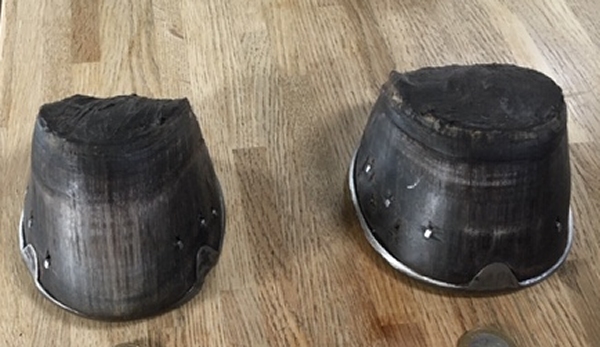
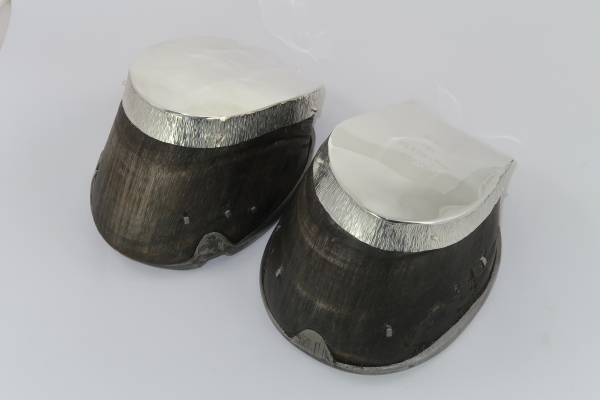
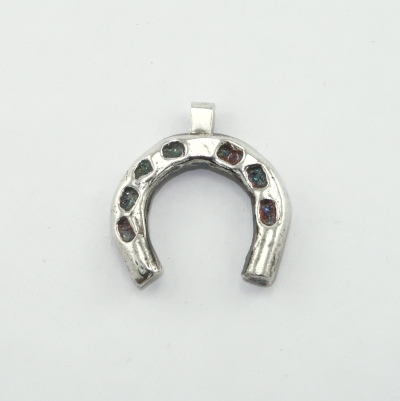
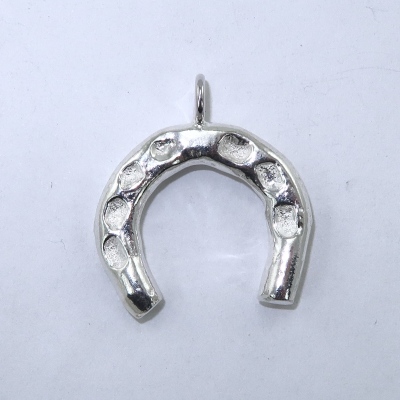
Of the 80 or so pieces of silver I’ve made this year this has to be my zenith for the year – the challenge of making covers for two horses hooves. A common Victorian activity – very often as inkwells.
From this
Copyright with the owner
To this
Each top is engraved with the name of the horse. A really interesting challenge to match the irregular shape, but both the owner and I are very pleased with the result. Fully UK hallmarked at the London Assay Office. The shoes are iron.
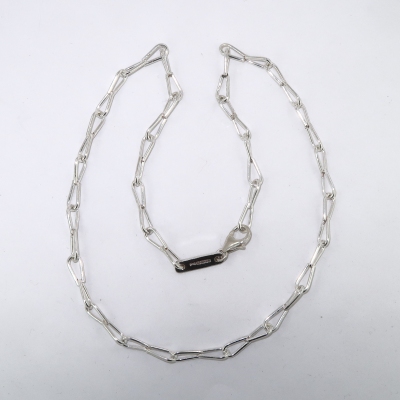
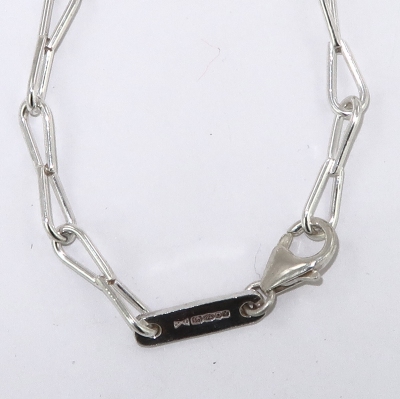
This is a gift for my wife. The book on chains I used as the basis for the design calls it ‘jeweller’s delight’, because it looks good and is relatively easy to make. True – especially as the way I made it was simpler and more effective than the method in the book. Here’s the chain and a close up showing the plate whose sole function is somewhere to put the hallmarks.
Each link is about 25mm long. The links and the plate are fine silver, but the lobster catch is sterling. That’s why the links are brighter than the catch. However it is only hallmarked as sterling silver.
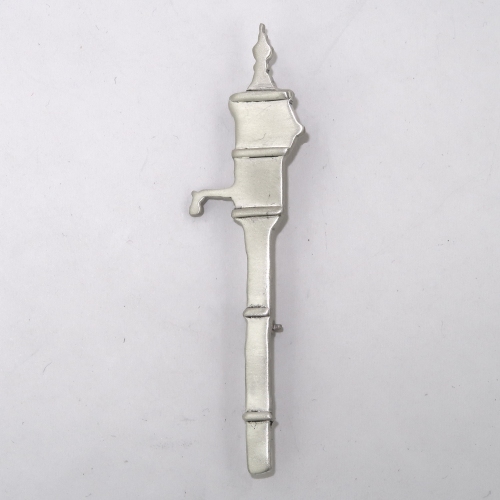
Dr John Snow is famous for several reasons, but one is his analysis of the incidence of outbreaks of cholera in London in 1954. He caused the removal of the handle of one particular pump in Soho, London that was dispensing contaminated water. There is much more about him on the internet e.g. wikipedia.
This is a representation of the pump as a sterling silver brooch. It’s about 7cm tall.
My client, an ex-medic, wanted a special gift that reflected his experience in epidemiology.
He said “John Snow pump received, looks just lovely, will be giving it to my wife later today. So very many thanks. A really wonderful and personal souvenir “
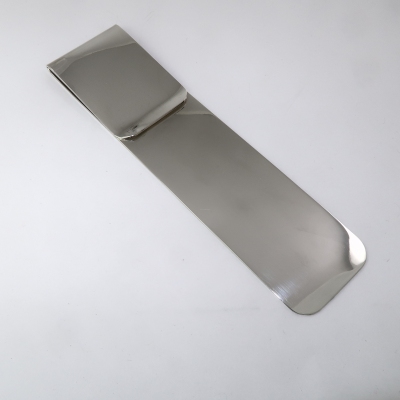
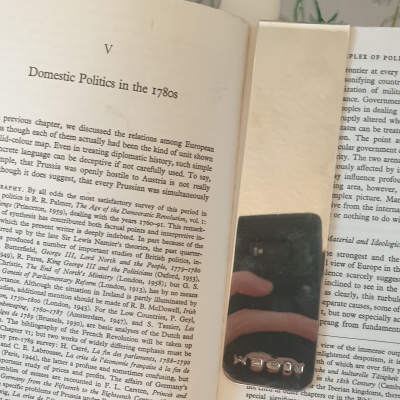
This request was for a substantial bookmark – longer and heavier than my norm. Also less maintenance required, so I used 1mm silver rather than 0.6 and argentium rather than sterling. Also the hallmark placing is different. Here it is as sent and then in use.
My client said “I think it looks very lovely, and it has a real heft in the hand which is nice.”
I was asked to make a silver yantra to my client’s design. It remind me of the Buddha. With this sort of wire bending, I can’t make two exactly the same. My client preferred the right hand side one. The main body is about 5cm high. The available one is in the process of being assayed, though it is below the minimum weight.
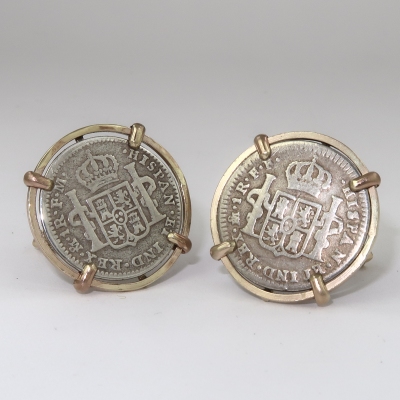
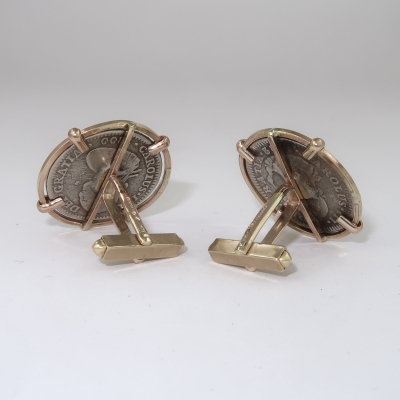
These Spanish real coins had been purchased as a set of cufflinks, where the cufflink part had been soldered directly on to the coins. I was asked to make 9ct gold settings instead with the design to be similar to an existing set with half-real coins. Good access to the back was required. I used commercial cufflink components in the design which holds the coins securely, but undamaged.
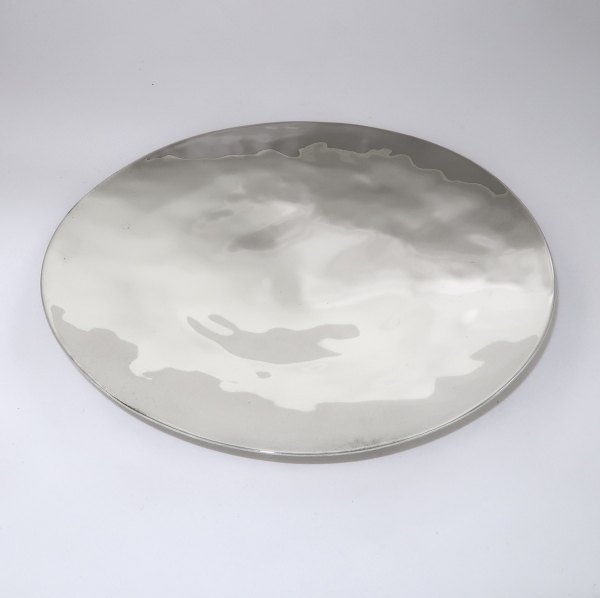
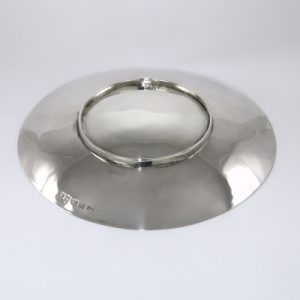
This sterling silver paten is destined for St Aldates Church in Oxford. A paten is used for communion bread.
“What an exquisite piece of silverware. It’s absolutely beautiful. “ St Aldates
It is 16 cm in diameter and has been hand made by sinking the silver into a wooden former.
Base of silver paten
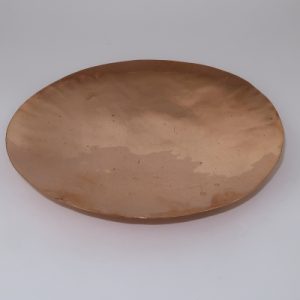
Copper test paten
The domed disk sits on a thin silver base ring – wide for stability. You can see the hallmarking on the image above.
I made a copper version first to check the size and design suited the donor. It’s an object of beauty in its own right and now resides in our house.
I have made other silver for ecclesiastical use. A morse for St Helens Church in Abingdon, a pectoral cross and ring for the Bishop of Hertfordshire and a pectoral cross for Abbot Thomas of Mucknell Abbey.
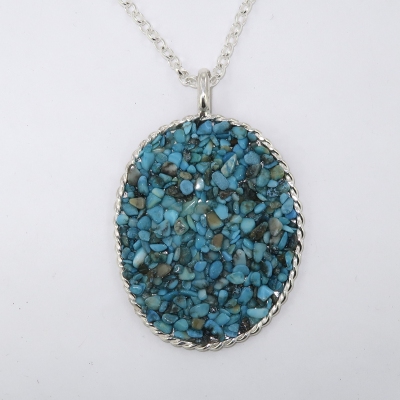
I made a twisted wire edged surround for a cameo. The cameo was far from flat, indeed the base had to be shaped like a certain potato based snack that comes in tins. Unfortuntately, I didn’t get the clearances quite right. I’ve mananged to repurpose the base by flattening it and forming a layer of turquoise chips.
It’s quite a statement piece as the oval is about 55 by 40mm. There are two morals to this story – reuse before recycle and never throw anything away. I’ve had that jar of turquoise chips for over 40 years! A unique piece available from my shop.
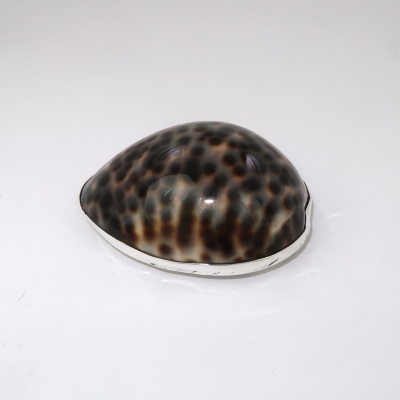
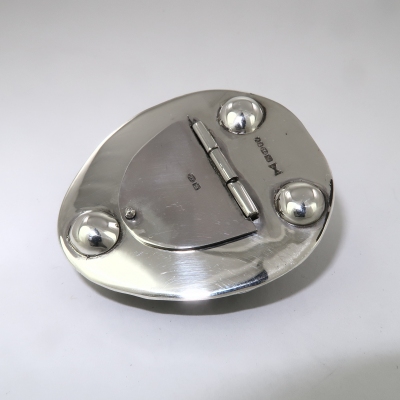
This is for me! II’ve finally finished it. It’s been a project long in the gestation since I was asked if I had any Cowrie shell snuff boxes several years ago. So I thought I would have a go at a shell topped box. I had to slice the top of the shell and then fabricate the base from silver. It’s about 10cm long.
This one wouldn’t work for snuff or other powders as the flap isn’t a tight enough seal, but fine for other small knick-knacks. You can see that the London Assay Office has applied part marks on the flap for me.
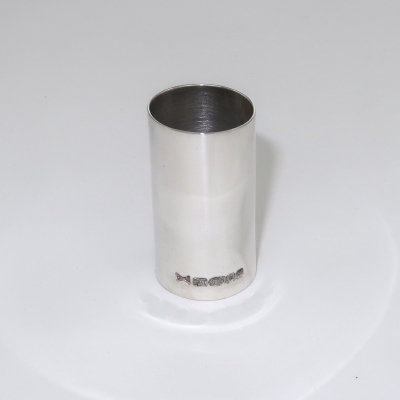
This is a collar to fit a leather bound officer’s cane. The original had disappeared. The tube was fabricated from sheet as it wasn’t a standard tube size.
I quote
The collar arrived safely and fits like a glove! Thanks very much indeed for making it for me. It’s just what I wanted.
I make each collar to my client’s requirements and prices vary considerably depending on a number of factors including the diameter, length, whether it matches a standard tube size, size and positioning of hallmarks, any additional embelishments or engraving. Prices start around £60 for a basic cylinder with discrete hallmarks.
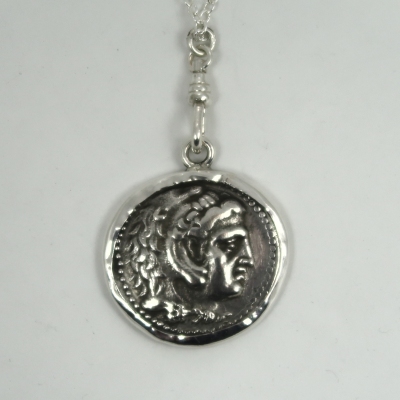
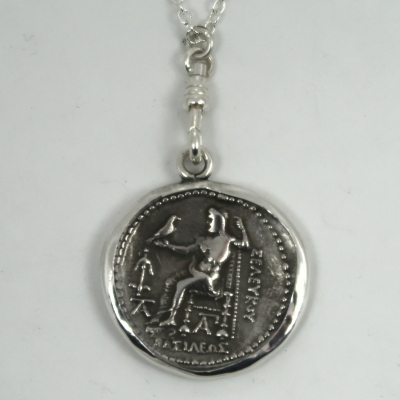
I’m not sure of the denomination of the coin, but it’s bigger than the denarius I recently mounted. Silver, about 20mm across and 2mm thick. It has a swivel so that both sides are easily viewed and a heavy trace chain consistent with the coin size. The mount is a fine silver band moulded non-destructively to the coin.
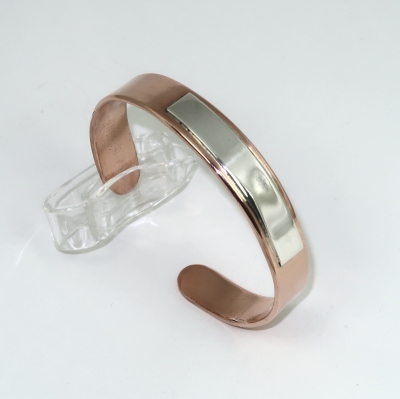
Heavy duty copper bracelet with a silver plate for engraving
This is 2mm thick copper and longer than I would normally make especially for a big lad. Unfortunately I couldn’t get it engraved in time, but that should be possible now.
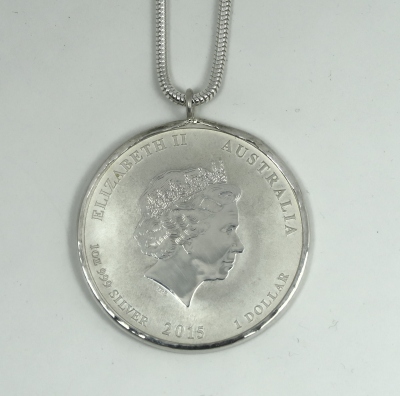
TI have mounted this beautifully manufactured silver dollar using a fine silver bezel burnished round to grip the coin securely. Only the milling round the outside is concealed. The setting holds the coin non-destructively and could be removed leaving the coin unscathed.
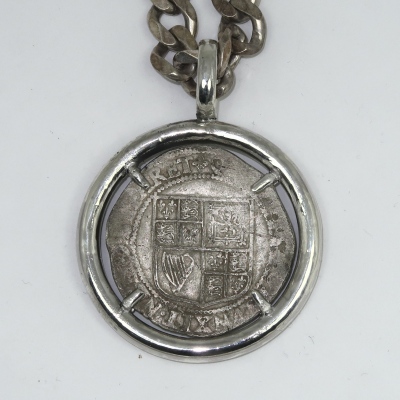
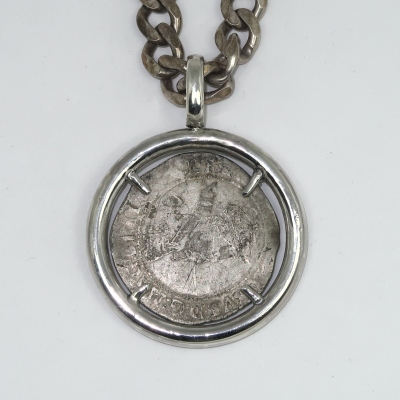
This coin mount for 1605 James the 6th Shilling – great to get the chance to hold something that old. The owner says that If you look at the coin you’ll see a fleur de lis around the edge, that’s the mint mark and means the coin was minted in the Tower of London in 1605, the very year Guy Fawkes tried to kill James the 6th.
The sterling silver mount holds the coin non-destructively and is hallmarked 2020.
The review posted on my Google page says ‘I received my item from John today and to say I’m happy with it would be an understatement. ‘
The left hand side is my delft clay copy of the original. As it only weighed 2.3g, no additional hallmarking was required. The owner was very pleased with the result.
On the left you can see it as received and on the right with a new pin catch and the chain reattached. Fortuately the beautiful filigree work on the front face remained intact.
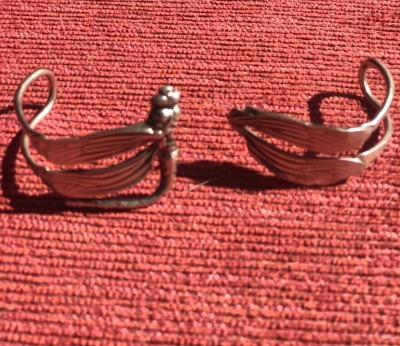
This style of bracelet has a design flaw. When the bracelet is flexed to get it on and off it work hardens and fails at the thinnest point which is the wing joint.
I managed to rejoin the wing and added a brace section underneath for added strength. It doesn’t affect the looks or wearability, but should make the bracelet last a good few years now.
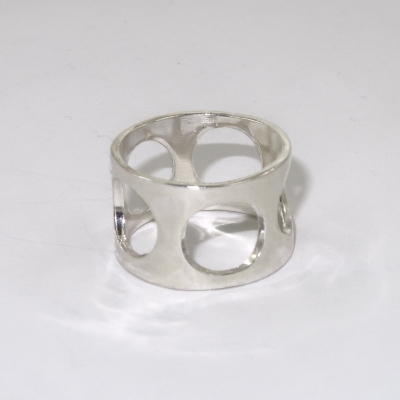
A special request for a ring with a groove around it. With time the groove should tarnish whereas the main surface will stay silvery. This will be the desired effect.
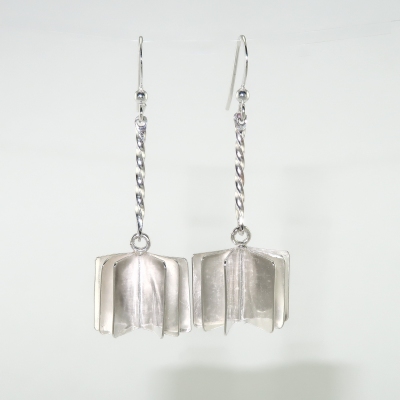
These were requested by a previous client for a friend who likes reading. My client provided a sketch, which I followed closely except that I replaced a chain by a twisted square wire to keep the book facing outward. There is still plenty of movement as there are two hinges. Another piece for my ‘unusual requests’ folder.
Royal Mail increased their prices on 23 March 2020. I haven’t increased my charges for some years as I have absorbed the costs. Alas, I can no longer do that and so from today have increased my p&p charges by just 25p for the two price bands.
Remember that is the price per posting to one UK address, so if you order more than one item you only pay one p&p charge.
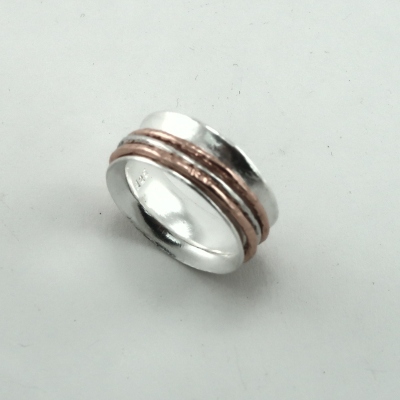
When I was asked to repair this ring, there were no floating rings – they had slipped off/ broken or otherwise vanished. Two copper and one silver ‘distressed rings were requested and delivered.
This one’s mine, though I can and have made copies.
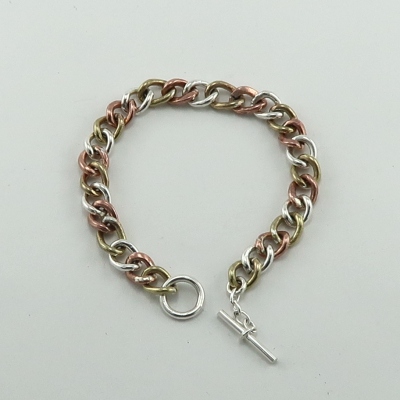
Mixed metal curb chain bracelet
It consists of a sequence of silver, copper and brass links with a silver t-bar and loop clasp. Of course, yellow, red and white gold is another option, but may not have the claimed beneficial effect of copper.
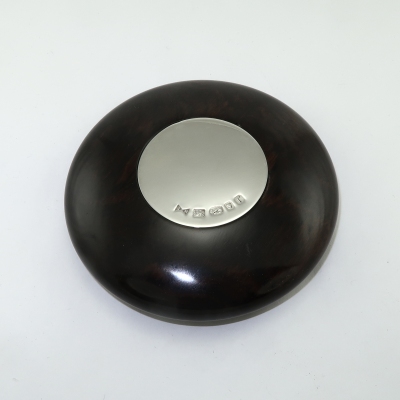
This post is a little sad. My friend Richard Shock has passed away. he was a woodturner and one of his lines was paperweights with different centrepieces. He asked me to obtain some silver discs and have them hallmarked as centrepieces. This is about 11cm across and weighed with lead. We think the wood is ebony. He wished me to have an item of his work to remember him and this is the piece that was selected for me. Very appropriate.
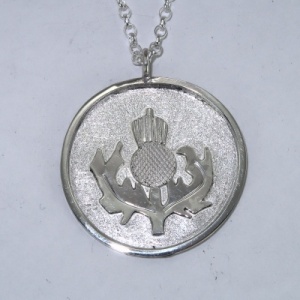
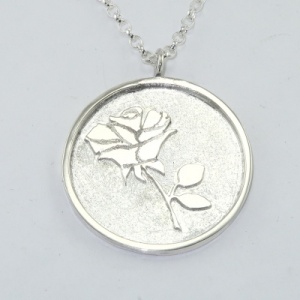
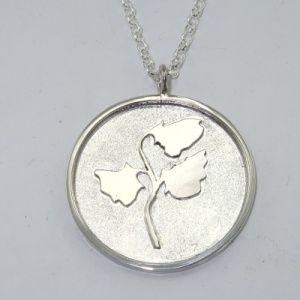
These pendants are a special commission for three daughters
Silver thistle pendant
Silver rose pendant
Silver sweet pea pendant
They are all the same size, about 35mm across, and build on earlier work in this style. The thistle is fabricated , but the rose and sweet pea are both cut in one piece from sheet – a challenge to my sawing skills. The textured background enhances the shiny surface of the flower. Each is hallmarked on the rear.
I was asked to make a silver near copy of a base metal pendant that had a special meaning for my client. I actually made two and the one on the left is the client’s and it has been slightly ‘aged’ on request. You can see it and the original here on Instagram. I quote
‘it’s arrived and frankly I am bowled over by how brilliant it looks. What an amazing job, it’s pretty much exactly how I imagined it. Thank you so much for the great work’
The right hand side one has a different fixing and is on sale in my shop. They are the same size – about 3cm by 3cm.
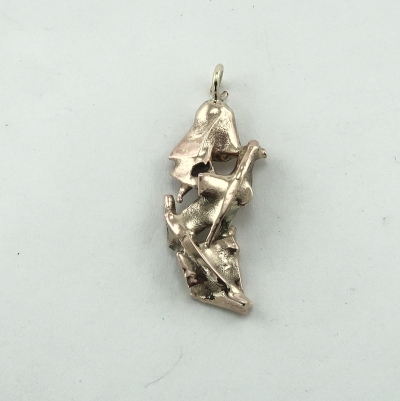
I’ve made many fused silver pendants before of a whole range of sizes, but this is my first attempt at fusing gold. I was unsure it would work with low carat silver but it’s come out fine and has been hgallmarked as 9ct gold. If you look carefully, you will see the two tones where the red and yellow gold pieces have blended together. This weighs 4g and is about 3cm tall. It’s available from my shop.
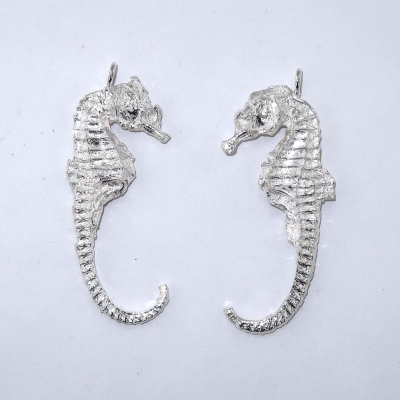
I helped to clear out the workshop of a silversmith who had passed away. In a tobacco tin, I found a dried out seahorse. I’ve no idea how old it was. I thought it would be fragile, but it has survived me making two delft clay casts from the body.
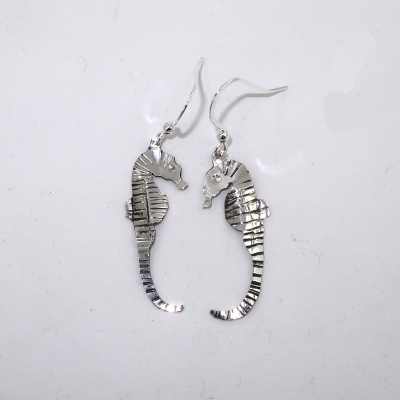
Sterling silver sea horses
They have come out really well and are available for purchase from my shop.
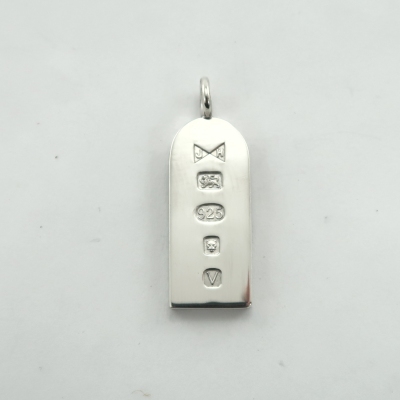
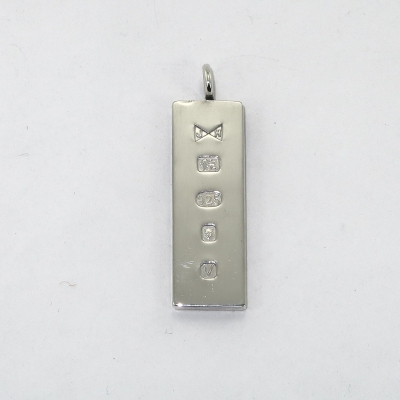
You can see all the date letters for the last 40+ years here. I made one for me every year and the one on the left is this year’s one. All 42, so far, are slightly different. The one on the right below is for sale in my shop, but I can make them pretty much any size or weight.
 After
After